
How to Use the AI Assistant
How to Use the AI Assistant
In this article:
- Overview
- How to open the AI Assistant
- Asking a question
- Mentioning people and content with @
- Asking about your data
- Asking how to do something
- Turning an answer into a graph
- Exporting an answer as CSV
- Context-sensitive suggestions
- Following up and managing conversations
- When it can't answer
- Giving feedback
- Things to keep in mind
- FAQs
- Who can do this
Overview
The AI Assistant answers two kinds of question about your platform: insights — real figures pulled from your own account, like who's overdue or how login activity is trending — and how-to — how to do something in the platform, answered from the help centre with links to the articles it used.
It's read-only. It looks things up and explains; it never creates, changes or deletes anything. And it only ever sees what your own permissions already allow, so it can't surface data you couldn't reach yourself.
How to open the AI Assistant
Click Ask AI at the top of any screen, or press ⌘ + K (Mac) / Ctrl + K (Windows). Either one toggles the panel — press it again to close.
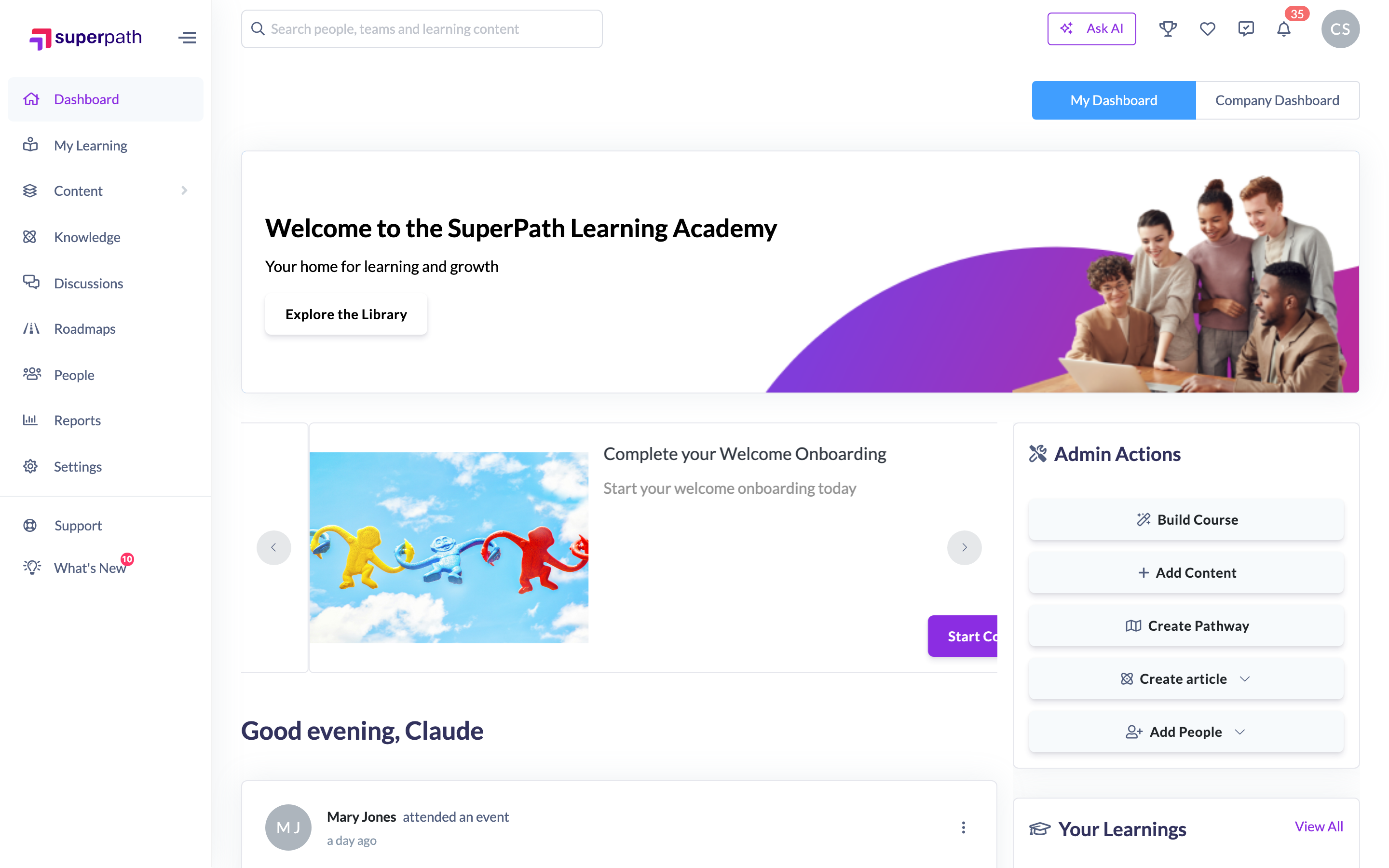
The panel docks to the right and pushes the page across rather than covering it, so you can keep working with the page while the conversation is open. It stays with you as you move between screens. On a narrow screen the left-hand menu collapses to its icon rail to make room, and expands again when you close the panel.
Asking a question
Type into the box at the bottom of the panel and press Enter, or click the arrow button. Ask in plain English — there's no query syntax to learn.
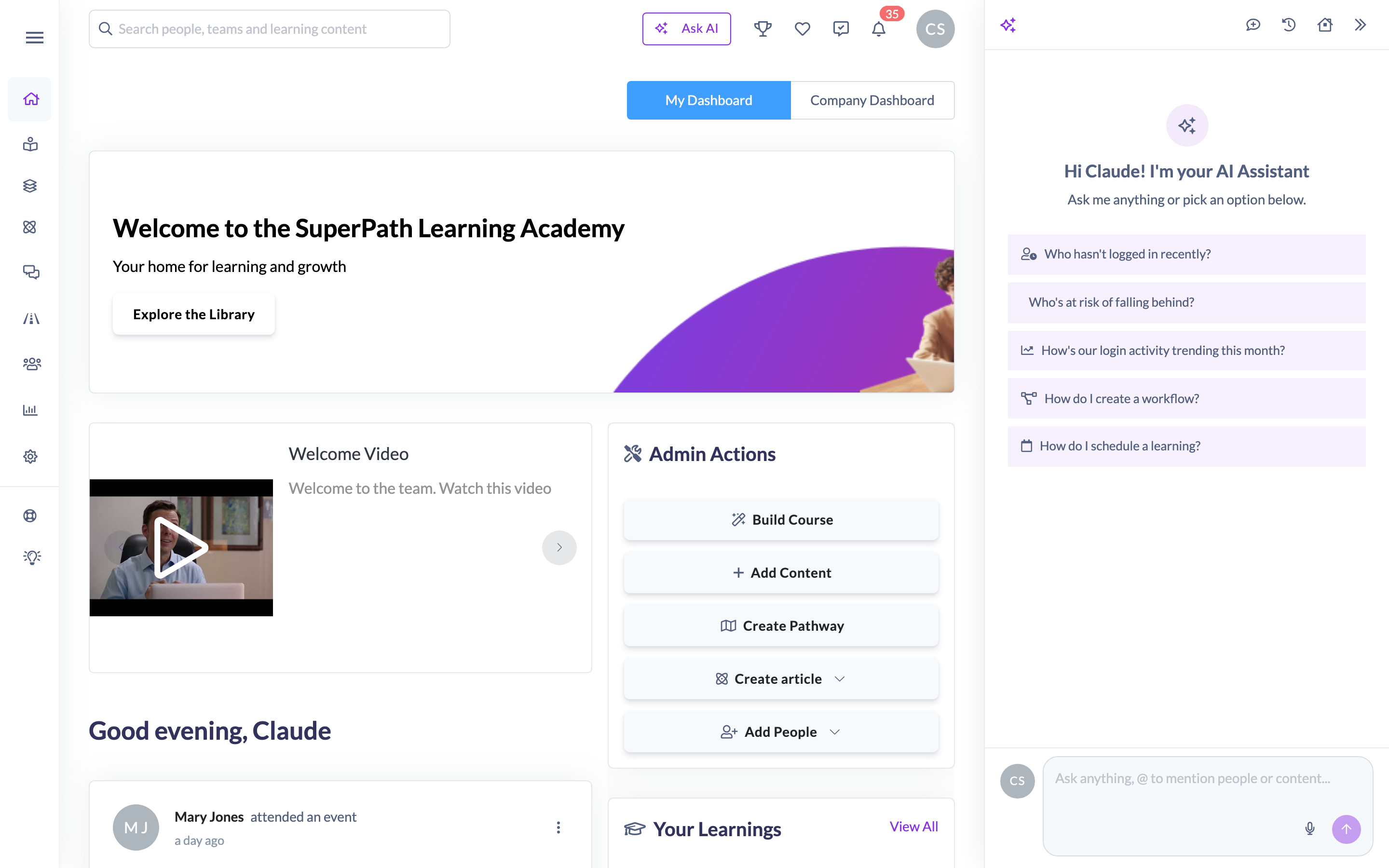
While it works you'll see a single status line with a pulsing icon, a changing label and an elapsed-seconds counter, then the answer streams in. Some other things worth knowing about the composer:
- Voice input — in Chrome, Edge and other Chromium browsers, a microphone button lets you dictate your question. It isn't shown in Firefox or Safari, where dictation isn't reliable.
- Message length — up to 10,000 characters per message.
- New conversation — the comment-plus icon in the panel header starts a fresh thread.
Mentioning people and content with @
If you're an Owner or Admin, type @ followed by a name to pin a question to a specific record instead of describing it in words.
- Type @ and start typing a name — "@Jane Smith", "@Onboarding 2026". Multi-word names are fine.
- A picker opens listing matches, each tagged with its type: person, content, pathway, form or event.
- Use the up and down arrow keys to move through the list, then Enter — or just click the one you want.
- The name is inserted into your message and the Assistant resolves it when it answers.
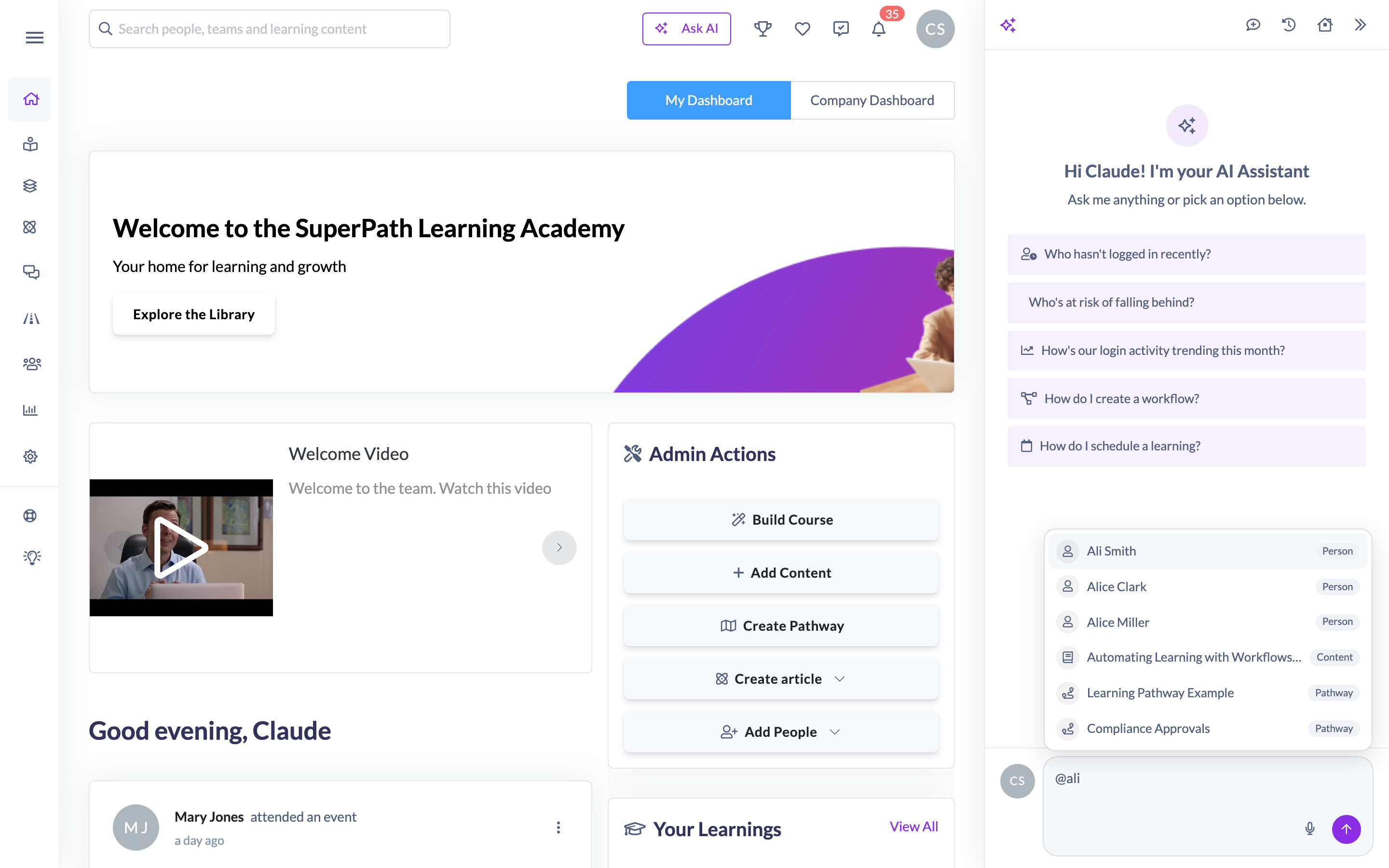
Scroll the picker to load more matches. Press Esc to close it without choosing.
Note: @-mentions are limited to Owners and Admins, because the search behind them isn't filtered by permissions. Managers and People Managers ask by typing names normally, and the Assistant resolves them within the people they're allowed to see.
Asking about your data
Data questions are answered by querying your account — not estimated. The Assistant can currently answer questions about:
- Login activity over time, by day, week or month, for a date range you give.
- Learning status counts — how many people have a pathway, course, form or event assigned, in progress, completed, overdue or due soon. This covers items assigned directly and as steps inside a Pathway.
- One person's learning record — what's assigned, in progress, completed, overdue or due soon for a named individual, and whether they've done a specific course or pathway.
- Learners at risk of falling behind, with the evidence for each signal: no recent login, stalled steps, an off-pace Pathway, or overdue and never-started assignments.
- Who's connected to something — who's assigned a Pathway, course, Form, Event or Roadmap; who belongs to a Team; who holds a Skill; who has a Certificate and when it expires.
- Knowledge article view counts, ranked most-viewed first, with total views and unique viewers per article.
Ask naturally — "Who's overdue on their compliance training?", "How many people completed Onboarding this quarter?", "How's our login activity trending this month?" Relative dates like "last month" or "this quarter" are resolved against today's date in your timezone.
A few behaviours to expect:
- If a name matches more than one person, it asks which one you mean rather than guessing.
- Long lists are capped. When there's more data than it can show, it tells you the real total and that the list is a sample — use Export as CSV for everything.
- Login activity is available for up to 36 months back. Ask for longer and the range is trimmed to that.
- It reports what the data shows, not why. Ask why a team is behind and it will give you the figures and say plainly that it can't determine the cause from learning data.
- It won't answer performance-management questions — who to promote, discipline or rank. Reporting who's behind on their learning is fine; turning that into a judgement about someone's employment isn't.
Asking how to do something
How-to questions are answered from the SuperPath help centre, and every answer shows its sources.
Ask something like "How do I create a workflow?" or "Where can I see errors from our HRIS syncs?" and you'll get the steps, followed by one or more source cards naming the help-centre articles used. Click the external-link icon on a card to open the full article in a new tab.
Where the article has a matching screen in the app, a Take me there button appears underneath with an "Opens Settings → Workflows"-style hint, so you can jump straight to it. The button is hidden when you're already on that page.

The Assistant answers how-to questions only from what those articles actually say — it won't invent a menu path or a setting. If the help centre doesn't cover your question, it says so rather than guessing.
Turning an answer into a graph
When an answer contains data that genuinely plots — a time series, or a split across two or more categories — a Show as graph button appears beneath it.
- Click Show as graph.
- The data is fetched fresh and drawn as a chart: a line chart (Activity over time) for anything measured over a period, or a pie chart (Breakdown) for a status split.
- An As of timestamp under the chart tells you how current the figures are.
- Click Copy to copy the chart to your clipboard as an image, ready to paste into a deck, doc or email.
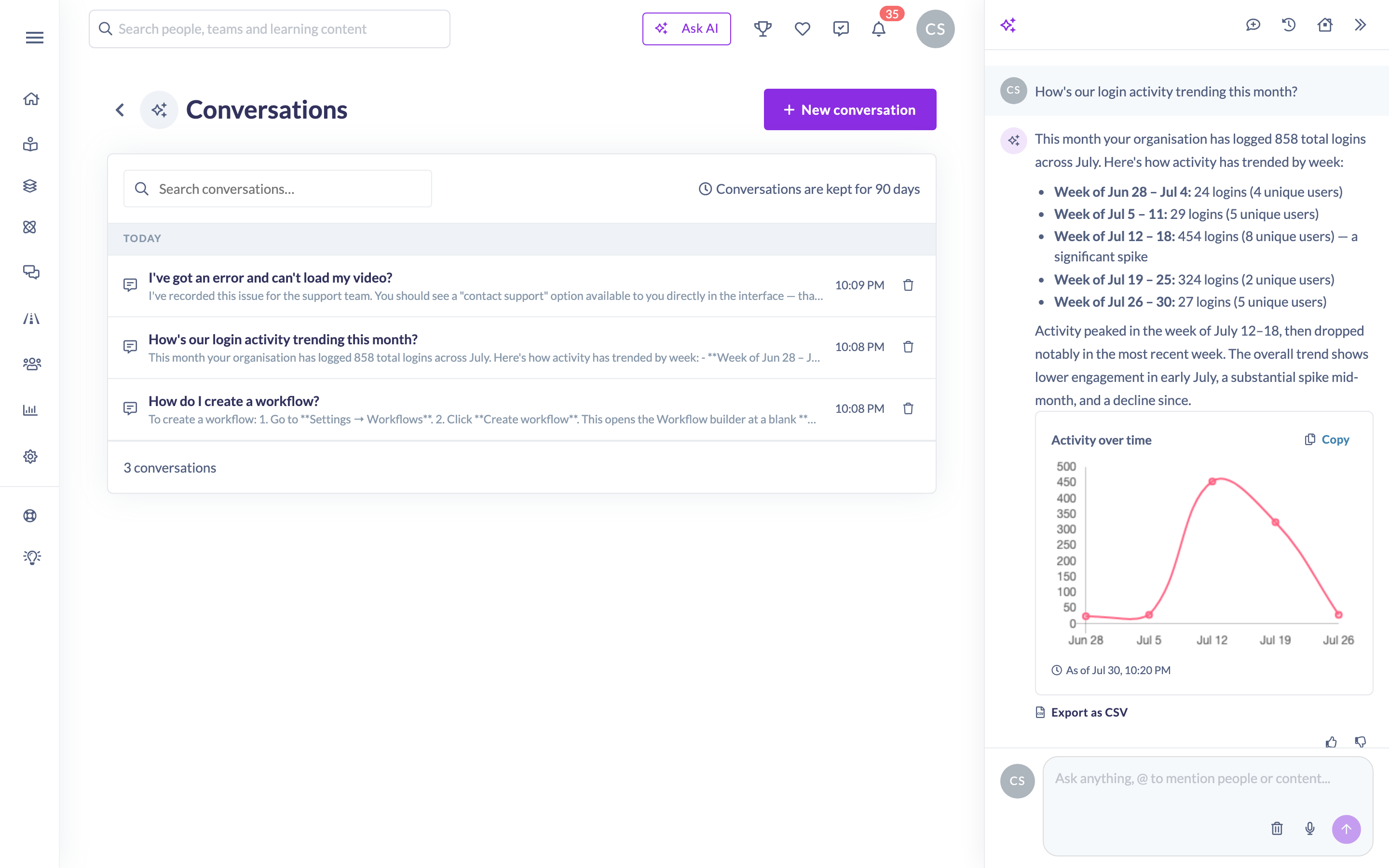
A single figure — "30 people in Engineering" — has nothing to plot, so no graph is offered. If data turns out not to be chartable once fetched, you'll see "This data can't be shown as a chart."
Exporting an answer as CSV
Answers built from per-person or per-row data offer Export as CSV beneath them. Click it and the file opens in a new tab.
This is how you get a complete list when the answer showed you a sample — the export isn't capped the way the on-screen list is.
Context-sensitive suggestions
The AI Assistant knows which page you're on, and uses it two ways.
A context chip. Open the panel on a person's profile or a Team and a chip appears under the header reading Looking at: Jane Smith. On a list or settings page it names the section instead — Looking at: Pathways. You can then ask about "this person" or "this team" without naming them. Click the × on the chip to clear the context.
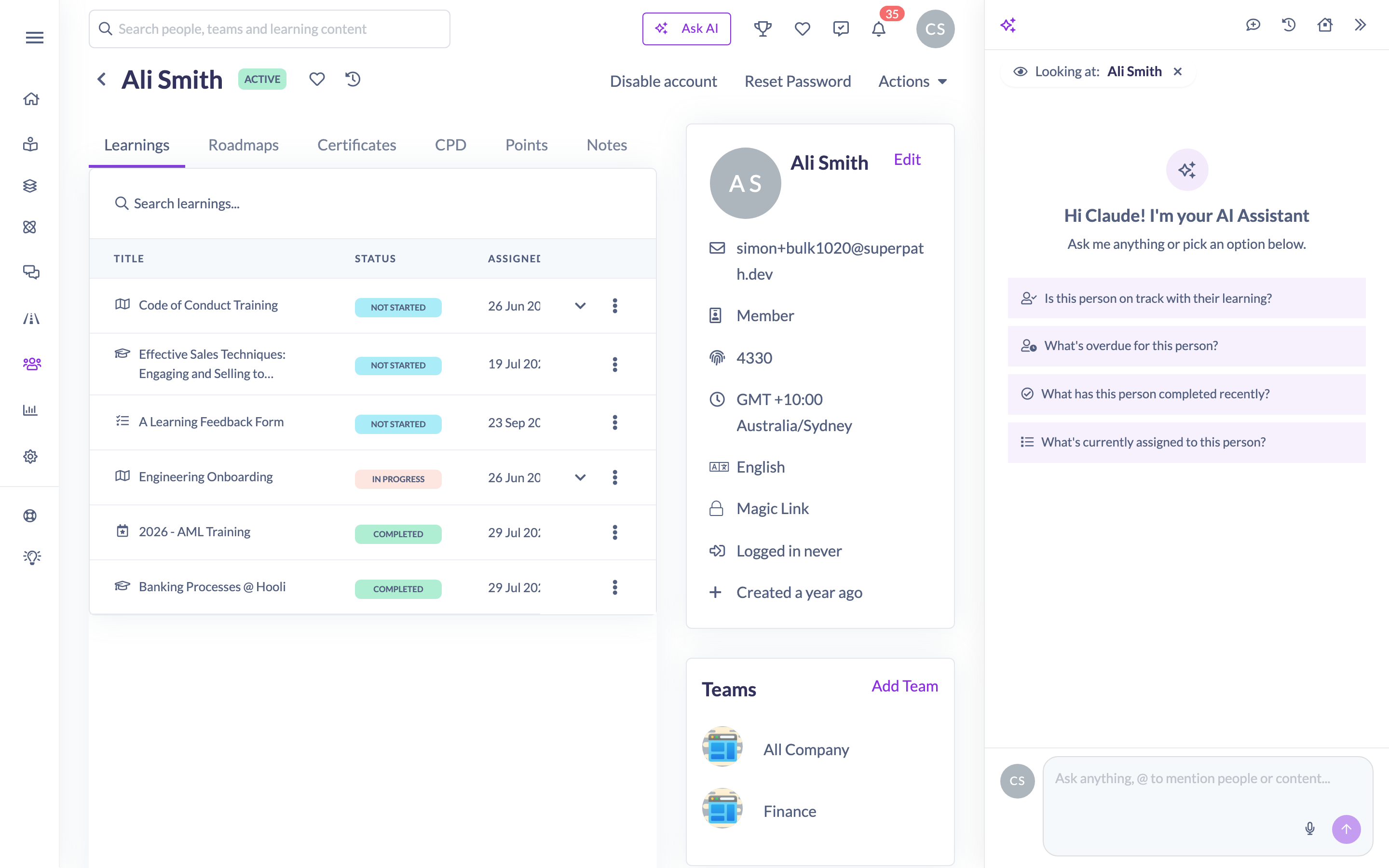
Suggested questions that match the page. A fresh conversation offers starter chips chosen for where you are:
Where you are | What it suggests |
|---|---|
A person's profile | "Is this person on track with their learning?", "What's overdue for this person?" |
A Team | "How is this team tracking overall?", "Who on this team is overdue?" |
People | "Who's overdue on their training?", "How are completions tracking this quarter?" |
Pathways | "Which pathways are overdue?", "How do I duplicate a pathway?" |
Library | "How many people completed a specific course?", "How do I assign a course?" |
Forms, Events, Knowledge, Roadmaps | Completion and attendance questions for that area, plus a how-to |
Settings | How-to questions — SSO, branding, workflows, connecting your HR system |
Anywhere else | The general set — at-risk learners, login trends, and two how-tos |
Click a suggestion to ask it. Some are deliberately open-ended — "Which pathways are overdue?" — and the Assistant will ask which Pathway you mean.
Following up and managing conversations
The Assistant remembers the conversation, so you can keep going without repeating yourself: ask "How many people are assigned Onboarding?", then just "How many finished it?"
From the panel header you can:
- New conversation (comment-plus) — start a clean thread.
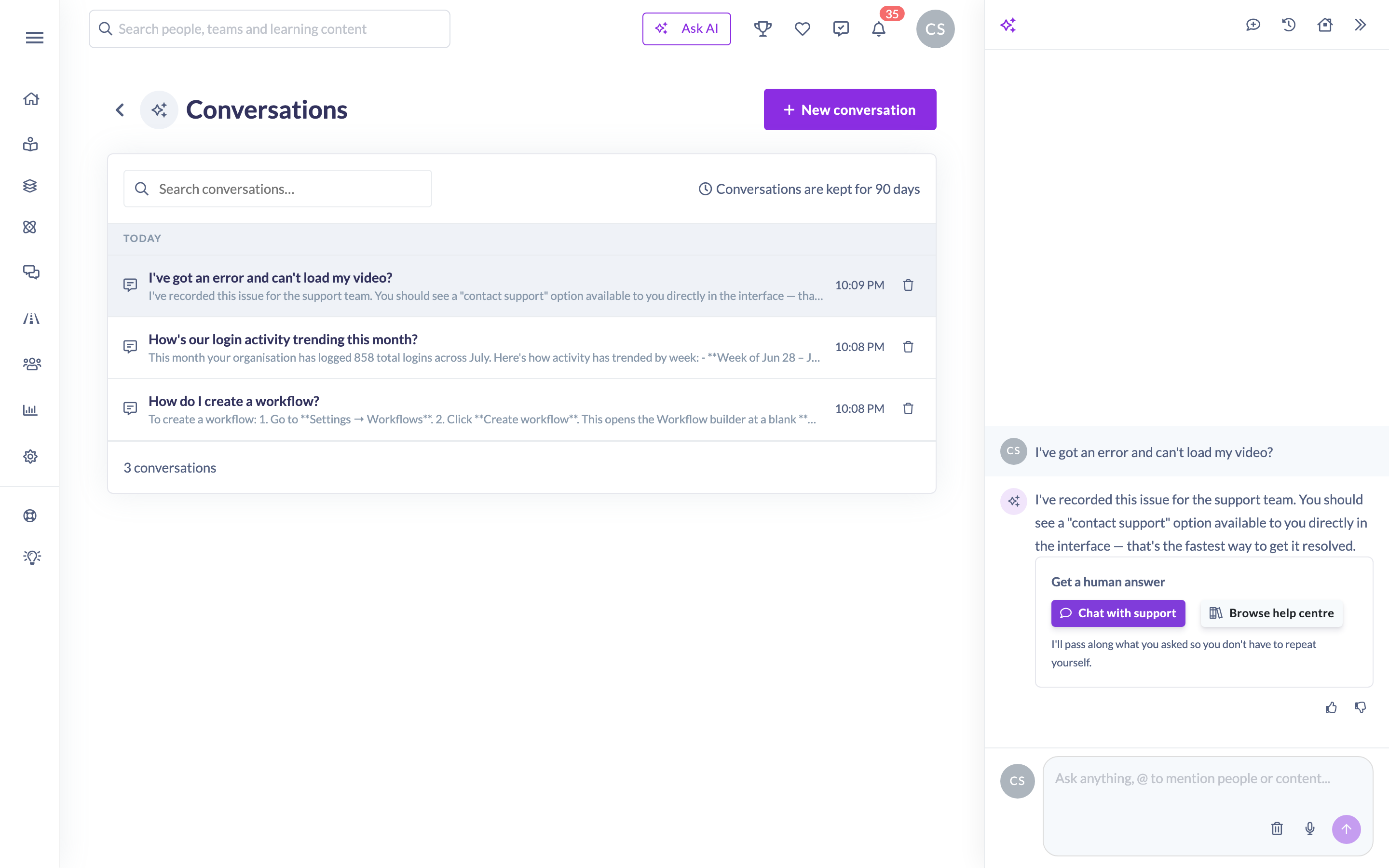
- Conversation history (clock) — list your past conversations grouped by Today, Yesterday, Previous 7 days and Older. Click one to reopen it, or View all for the full page.
- Open full page (house) — go to the AI Assistant home page. See The AI Assistant Home Page.
- Close (double-chevron) — close the panel. Nothing is lost.
When it can't answer
The Assistant is built to say "I don't know" rather than guess.
- It doesn't have the answer. If the help centre doesn't cover your question, it tells you plainly and shows a Get a human answer card with Chat with support and Browse help centre. Choosing Chat with support opens the chat with your question already filled in, so you don't have to type it again.
- Something looks broken. Report a fault — "my pathway isn't loading" — and it won't try to diagnose it. It records the report for the support team and offers the same Get a human answer card.
- The data is outside your scope. If you're a Manager and ask about someone who doesn't report to you, it says it can only show the people who report to you, rather than pretending there's an error or that the group is empty.
Giving feedback
Every answer has thumbs up and thumbs down buttons at the bottom right. Use them — they're how the Assistant's answers get better. Click the same thumb again to clear your rating.
Things to keep in mind
- The AI Assistant is read-only. It can't create, change or delete anything, and it can't perform tasks for you. It can always explain how you would do something.
- Answers are scoped to your own permissions. Owners and Admins see account-wide data; Managers and People Managers see only the people who report directly to them, and every figure is stated as their-team rather than company-wide.
- Login activity reporting is tenant-wide for Admins and covers up to 36 months back.
- Your organisation can send up to 500 messages a day across all users. The limit resets at midnight UTC.
- Conversations are private to you, and are kept for 90 days.
- @-mentions are Owner and Admin only.
- Voice input needs Chrome, Edge or another Chromium browser.
- While the panel is open the support chat widget is hidden so the two don't overlap; it comes back when you close the panel.
- AI can make mistakes. The figures come from your account rather than being estimated, but it's worth sanity-checking anything you're about to act on.
FAQs
Can the AI Assistant change anything in my account?
No. It's read-only in this release — it looks things up and explains, and never creates, edits or deletes anything.
Will it show me data I'm not supposed to see?
No. Every answer is scoped to your own permissions. A Manager asking a company-wide question gets the figure for the people who report to them, plus a clear statement that it only covers their reports.
Why does it keep asking which pathway or which person I mean?
It won't guess between plausible matches. Naming the item exactly — or @-mentioning it, if you're an Admin — skips the question.
Why is there no Show as graph button on my answer?
The data has to be genuinely plottable: a series over time, or a split across two or more categories. A single number has nothing to chart.
Can I copy a chart into a presentation?
Yes. Click Copy on the chart card and it goes to your clipboard as an image.
The list of people looks incomplete — why?
Long lists are trimmed on screen. The answer tells you the true total, and Export as CSV gives you the whole set.
Does it know what page I'm on?
Yes. A Looking at: chip shows the current context so you can ask about "this person" or "this team", and the suggested questions change to match the page. Clear it with the × on the chip.
Can it tell me why a team is behind?
No. It reports what the data shows, not the causes — it will give you the figures and say it can't determine why from learning data.
Can it help me decide who to promote?
No. It declines performance-management and personnel-decision questions. It will happily report who's behind on their learning.
How do I get a human?
When it can't answer, use Chat with support on the Get a human answer card — your question is carried across for you. You can also open the support chat any time from the help widget.
Who can do this
Who can use the AI Assistant depends on your organisation's Who can use the AI Agent setting. On Admins only it's Owners and Admins; on Admins and managers it also covers Managers and People Managers. Content Managers are deliberately excluded from the manager tier — the role manages content rather than people, so there's no team scope to bound its results to — and Instructors, Employees and Restricted users cannot use it on either setting. The Ask AI button simply doesn't appear for anyone who can't use it, and the server enforces the same rule.
Owners and Admins get account-wide answers plus @-mentions. Managers and People Managers get answers scoped to the people who report directly to them, and no @-mentions. Turning the AI Assistant on and choosing the access level is done in Settings → Features by an Owner or Admin — see Managing AI Features.
Updated on: 30/07/2026
Thank you!